
ADOC Search for Etowah Custody
The Alabama Department of Corrections public search should be used with a clear boundary. The ADOC search page says its database only contains currently incarcerated inmates and that historical data is not available online. That is the central fact for Etowah County release research. ADOC can help while a person is serving a state sentence, but it should not be described as the place to find every released Etowah County inmate.
For local jail custody, use the Etowah sheriff's 48-hour release roster, Detention Center contact, and court records. For state prison custody, use ADOC inmate search. If the person no longer appears in ADOC, do not treat absence alone as proof of release. The person may have been released, but the public search also has exclusions and does not provide online historical release data. After state custody, ABPP, VNS, court records, and formal records contacts may be needed.
The ADOC search screenshot below is the matching manifest image for the state custody route and the historical-data warning.
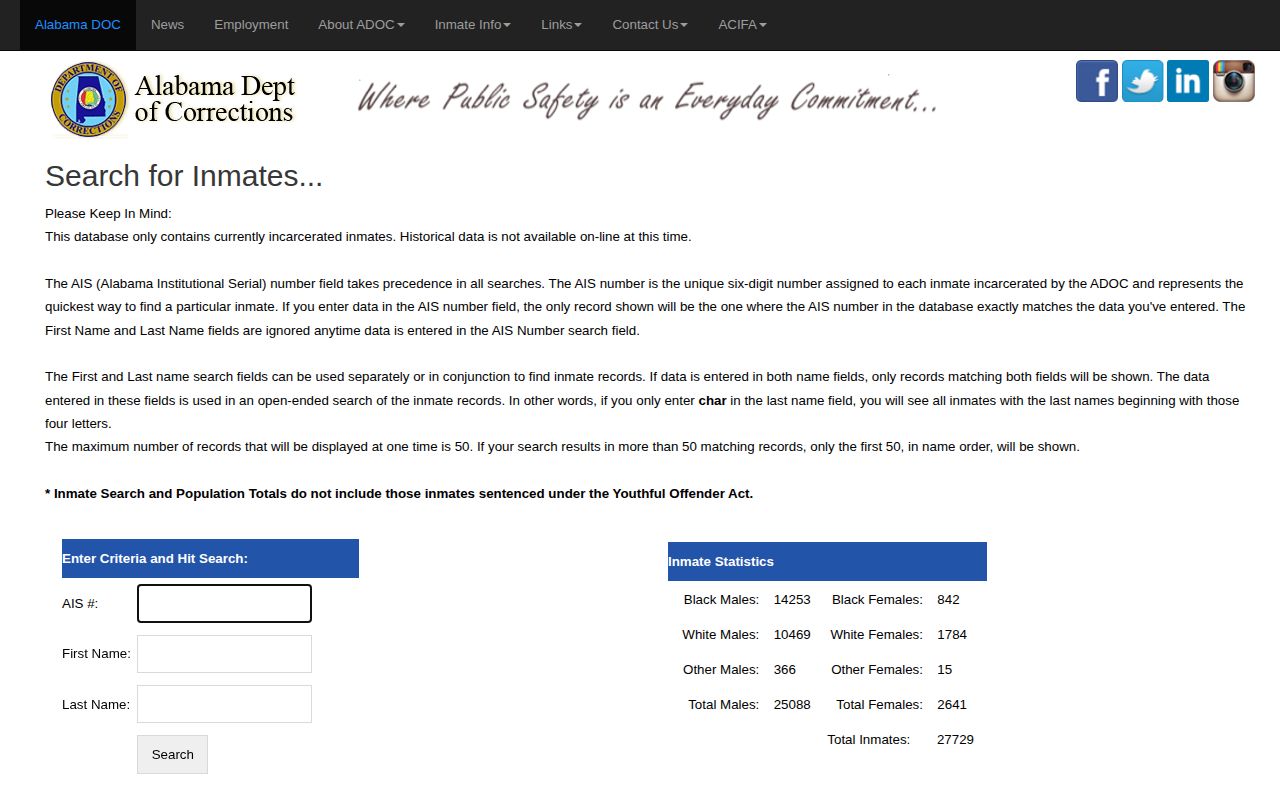
That warning keeps the Etowah release workflow honest: current state custody belongs in ADOC; older local jail releases belong with sheriff and court records.
Search ADOC Current Custody
ADOC accepts AIS number, first name, and last name. The AIS number is the unique six-digit number assigned to an incarcerated ADOC inmate, and the research notes that it takes precedence over name fields. If the AIS number is unknown, use the name fields. ADOC name searching is open-ended, so partial last names may return beginning matches. Results are state-prison records, not Etowah County jail release records.
- Confirm that the person was sentenced to ADOC rather than only booked in the county jail.
- Search by AIS number first if it is available from court or custody paperwork.
- Use first and last name when the AIS number is unknown, and compare identifiers before relying on a match.
- Review current facility, sentence, and release-date concepts only as ADOC state-prison data.
- If the person is missing from ADOC, verify through ABPP, VNS, the Etowah court file, or records contacts instead of assuming the reason.
| Search field | Use | Limit |
|---|---|---|
| AIS number | Best exact state-prison identifier. | Applies to ADOC inmates, not county-only detainees. |
| First name | Helps narrow name search. | Can return multiple people. |
| Last name | Can be used with partial beginning matches. | Needs identity checks before relying on a result. |
ADOC Release Date Fields
ADOC definitions are valuable even though the search is current-custody only. ADOC defines Minimum Release Date as the earliest scheduled date an inmate can be released to probation or end of sentence. It also says the date can change if the inmate receives disciplinaries that take away good time or if the circuit clerk sends new cases or changes the current sentence. That makes the minimum date a custody calculation, not a guaranteed release event.
The ADOC definitions page also defines Jail Credit, Good Time Received, Good Time Revoked, Parole Consideration Date, and Parole Status. Jail credit points back to the sentencing county's circuit clerk. For an Etowah sentence, a jail-credit dispute or sentence-change question may require the Etowah court record, not just ADOC.
| ADOC term | Release meaning |
|---|---|
| Minimum Release Date | Earliest scheduled release to probation or end of sentence, subject to change. |
| Jail Credit | County jail time before sentencing, prepared by the circuit clerk. |
| Good Time Received | Sentence deduction credited under state rules. |
| Good Time Revoked | Good time removed after discipline. |
| Parole Consideration Date | Review timing, not a guaranteed release date. |
Note: Use Etowah County release date lookup for the broader projected-release explanation.
After ADOC Release
Once a person leaves ADOC custody, the public inmate search may no longer be enough. A release to parole, mandatory release, medical parole, or another supervised status can point to the Alabama Bureau of Pardons and Paroles. Etowah County is served by the Gadsden Field Office. VNS may also provide custody or parole-action notifications for covered Alabama state-prison offenders, but VNS is not a county jail release roster.
ADOC's Reentry Contact page lists 334-353-9739 for questions regarding an inmate's mandatory release, while also saying the page is not intended to answer many individual case questions. ABPP's FAQ points mandatory-release eligibility questions to ADOC at 855-937-2362. Those limits matter because public web pages may not resolve a specific release dispute. The Etowah court record can also show sentence, jail credit, and orders that feed state calculations.
ADOC and Etowah Contacts
ADOC is a statewide system, so the local Etowah office is not the custodian of the prison database. The local court remains important when Etowah County sentencing records, jail credit, or court orders are part of the release-date question. For supervision after prison, use the Gadsden ABPP Field Office.
Alabama Department of CorrectionsPublic search: doc.alabama.gov/inmatesearch.aspx
Mandatory release contact334-353-9739
ABPP FAQ also points mandatory-release eligibility questions to ADOC at 855-937-2362.
Etowah County Circuit Clerk801 Forrest Avenue, Suite 202
Gadsden, AL 35901
256-549-2181
Use for Etowah court orders, sentencing records, and jail-credit source documents.
For an Etowah County user, the practical sequence is simple: sheriff records for a county jail release, Circuit Clerk records for sentence and disposition, ADOC for current state-prison custody, and ABPP for supervision after state release. Keeping those systems separate prevents a common error. A person missing from ADOC may be released, but the public search's current-custody limit means the absence must be checked against the court, ABPP, VNS, or records contacts before it is treated as final.
ADOC definitions also show why the Etowah court can still matter after a state transfer. Jail credit is prepared by the sentencing circuit clerk, and sentence changes can move the minimum release date. If a family member or attorney is trying to understand a changed state release date, the court order and clerk record may be just as important as the ADOC screen. The public search gives the current custody snapshot, while the local court file can explain the source documents behind that snapshot.
The same division applies to notifications. Alabama Victim Notification System can be useful for covered offenders convicted in Alabama and sentenced to prison, but the VNS source says pretrial case questions belong with the sheriff in the county where the crime occurred. For Etowah County, that means a jail bond release and a state-prison release should not be merged into one search path. ADOC, VNS, ABPP, the sheriff, and the Circuit Clerk each answer a different part of the release record.
Etowah to ADOC Handoff
The Etowah-to-ADOC handoff begins in the court file. A county jail booking can become a state-prison case only after a sentence or custody order sends the person into ADOC control. The sheriff roster may show that the person left local custody, but ADOC is the source only after the person is actually in current Alabama prison custody. That is why the Etowah Circuit Clerk remains important for sentencing orders, jail credit, and case changes that can affect a minimum release date.
When ADOC shows a current inmate, save the AIS number and compare it with the court record. When ADOC does not show the person, use the current-custody limit before drawing conclusions. A release, transfer, exclusion, data change, or non-ADOC custody path can all produce a missing result. For post-release supervision, ABPP and the Gadsden Field Office can be more useful than the ADOC public search.
ADOC definitions also explain why a release date can move. Discipline can affect good time, the circuit clerk can send new case information, and a parole consideration date is not the same as physical release. For Etowah County cases, the local sentence documents and state custody screen should be read together before treating any date as final.
Public Record Search
Sponsored Results