
Etowah Registry Release Role
A person released from jail or prison may appear in the sex offender registry only if the conviction and registration law require it. The Etowah County Sheriff's Office links to an OffenderWatch or iCrimeWatch registry page, while ALEA's sex offender registry is the state-level repository. Local law enforcement registers offenders and forwards information to ALEA. That makes the registry a post-release public record source for a narrow class of released people, not a roster of everyone released from Etowah County custody.
For ordinary county releases, the sheriff's 48-hour release roster and court records remain the better path. For a state prisoner, ADOC and ABPP may explain custody and supervision status. The registry becomes relevant when a qualifying registrant has public registration information after release, including a photo or address-area data if disseminated. Absence from the registry is not proof that a person was never released.
ALEA and OffenderWatch
ALEA says the Alabama registry contains more than 16,000 offenders and that ALEA maintains the state repository. Etowah's sheriff site points users to its local OffenderWatch / iCrimeWatch search. These systems are related, but the research supports using both carefully: ALEA is the statewide source, while the Etowah-linked OffenderWatch entry is the local registry search path.
The ALEA Community Information Center is the state registry search entry point.
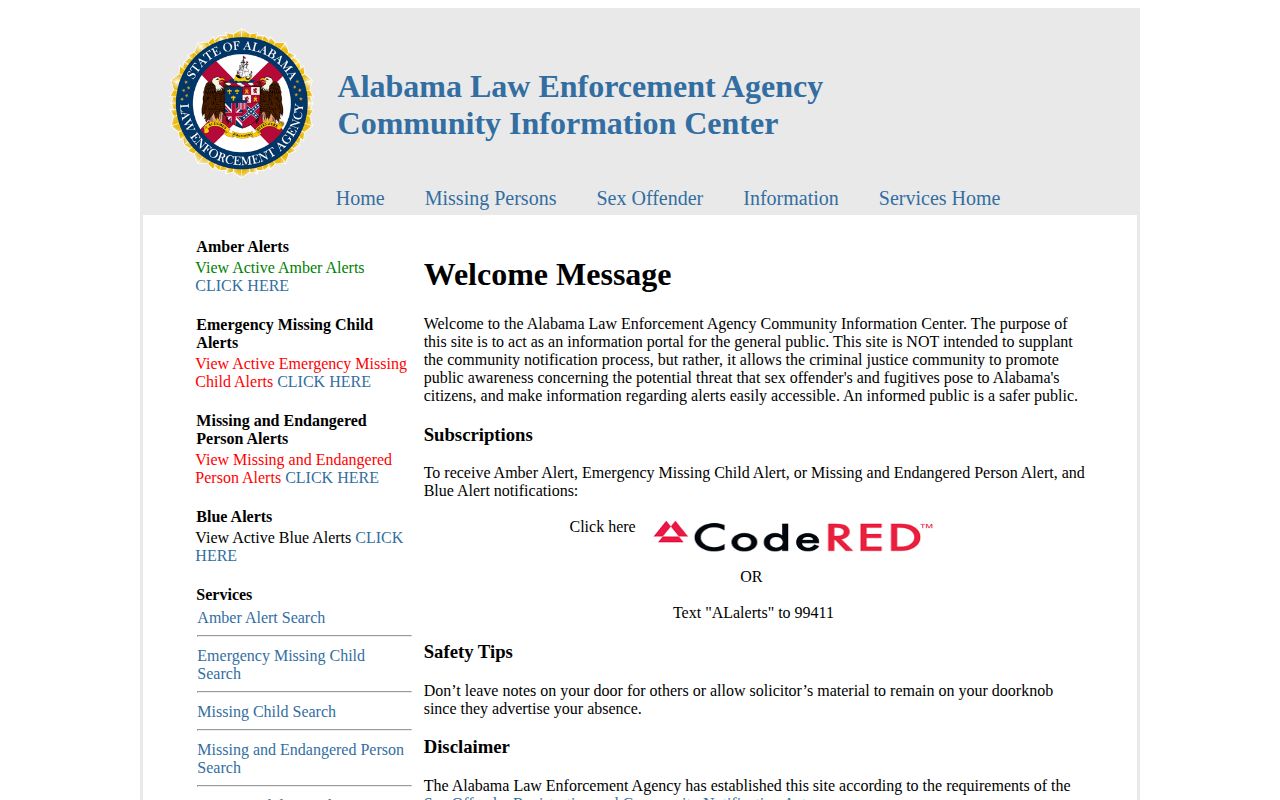
Use the image as a source cue for the state registry path. For local Etowah results, also check the sheriff-linked Etowah OffenderWatch registry when it is accessible.
| Registry Channel | What It Confirms |
|---|---|
| ALEA registry | State repository information available for public dissemination. |
| Etowah OffenderWatch | Local registry search linked from the sheriff's public resources. |
| Etowah court records | Disposition, sentence, orders, and expungement effects behind the case. |
| Sheriff release roster | Short-window county jail release details, not registry status. |
Public Registry Limits
ALEA notes an important dissemination limit: not all offenders are publicly disseminated. Juvenile, youthful-offender, and out-of-state status can affect public visibility. That means a registry search result should be read as a public registry result, not as a complete legal history. Some records may be restricted, incomplete online, or outside the public registry view even when a court file exists.
These limits also prevent overbroad conclusions about released Etowah County inmates. A person who is not required to register will not appear in the sex offender registry for that reason alone. A person whose registry information is not publicly disseminated may also be absent from the public search. Use the registry for qualifying registrants, then use the court docket, sheriff record, ADOC record, or ABPP record to answer release and sentence questions.
Search Etowah Registrants
The registry search workflow should stay specific. Search by the facts the registry supports, then separate registry status from custody status. If the task is to confirm that someone left the Etowah County Detention Center, the registry is usually a later channel. If the task is to confirm whether a released qualifying registrant has public registration details, the registry is the correct channel.
- Start with the Etowah OffenderWatch registry or ALEA Community Information Center.
- Search by name, address area, or other fields offered by the active registry interface.
- Compare identifying details carefully before treating a result as the correct person.
- Use the Etowah court file to confirm conviction, sentence, and later orders.
- Use sheriff, ADOC, ABPP, BOP, or ICE channels to confirm the custody release path.
- Registrant
- A person with a legal duty to register after a qualifying offense.
- Public dissemination
- The portion of registry information that Alabama makes visible to the public.
- Disposition
- The court outcome that explains conviction, dismissal, sentence, or other case status.
Etowah Release Records Compared
Etowah County release verification depends on which public system is answering the question. The sheriff's 48-hour release roster can show a release date and booking details for recent local jail releases. The court file explains the legal case outcome. ADOC search is for current state prisoners and is not a complete historical release archive. ABPP handles post-release supervision. The sex offender registry is narrower than all of those sources because it is offense-specific.
If the registry does not return a public result, continue with the custody source that fits the release event. The missing registry result may reflect no registration duty, a dissemination limit, or a record outside the public registry view.
| Question | Better Source |
|---|---|
| Was the person just released from county jail? | Etowah sheriff 48-hour released roster or Detention Center records. |
| What was the case outcome? | Etowah County Circuit or District Court records. |
| Is the person on state supervision? | ABPP sources and the Gadsden Field Office. |
| Is public registry information available? | ALEA registry and Etowah OffenderWatch. |
Use Mugshots of Released Inmates for booking-photo source differences and Etowah County released inmates for the full release-record search chain.
Etowah Registry Release Context
The sex offender registry is a post-release public-safety registry, not a general Etowah County released-inmate list. It can be relevant only when the conviction and registration rules apply. A person may be released from jail or prison and never appear in the registry because the offense does not require registration, the record is not publicly disseminated, or another statutory limit applies.
When a registry result exists, use it as a current registration source and then check the court file for disposition and the sheriff or ADOC record for the custody path. The registry may show a photo and address-based public information, but it should not be used to infer details about every prior booking or every release event from the county jail.
ALEA says local law enforcement registers offenders and forwards information to the state repository. Etowah's sheriff menu links to an OffenderWatch search page, while ALEA maintains the statewide Community Information Center. That split means a user may see both local and state entry points, but both are registry channels. They are not substitutes for the Etowah sheriff's release roster, Circuit Clerk records, or ADOC current-custody search.
| Question | Registry answer |
|---|---|
| Is the person a publicly listed registrant? | Check ALEA or the Etowah OffenderWatch entry point. |
| Was the person released from county jail? | Use the sheriff release roster or Detention Center records. |
| What was the case outcome? | Use the Etowah Circuit Clerk court record. |
| Why is there no registry result? | The offense may not qualify, publication may be limited, or another status rule may apply. |
This distinction matters for mugshot and release searches. A registry photo can remain visible after a jail roster photo expires, but only for qualifying registrants. A missing registry photo says nothing about whether a non-registrant was released from Etowah County custody.
Registry Record Limits
The registry can answer current public registration questions, but it does not explain the whole custody history. It may not show the booking number, the county jail release date, the arresting agency, or the bond and charge fields from the sheriff roster. It may also omit people whose records are not publicly disseminated because of juvenile, youthful-offender, out-of-state, or other limits noted by ALEA. That is why a registry result should be paired with the court file and the correct custody record.
For Etowah County release work, use the registry after the qualifying conviction question is clear. Use the sheriff for the jail release, the Circuit Clerk for disposition and expungement, ADOC for current state custody, and ABPP when supervision follows. The registry is a narrow public registry channel, not a replacement for those systems.
Public Record Search
Sponsored Results