
Etowah Court Release Path
The Etowah County Circuit and District Courts are the durable record path after the jail roster expires. The Etowah Circuit Clerk's home page says a public access computer is available in the Circuit Clerk's office for searching court record information. The record request page says most court records are public and open for inspection, then directs users to request copies after the needed record is found. This matters because a jail release entry does not always show the legal reason for release.
Use the court path when the question is whether bond was posted, a case was dismissed, charges were amended, a sentence was imposed, probation was ordered, a warrant changed custody status, or a record later became restricted. The jail record is a custody record. The court record is the legal status record. A person can be released from Etowah County Detention Center and still have a pending case, reporting conditions, future court dates, or an order that explains why they left custody.
The AlaCourt and Just One Look court portal can be a faster case-by-case route when the user has enough identifying information. The Circuit Clerk route remains important for public terminal searches and certified or mailed copies.
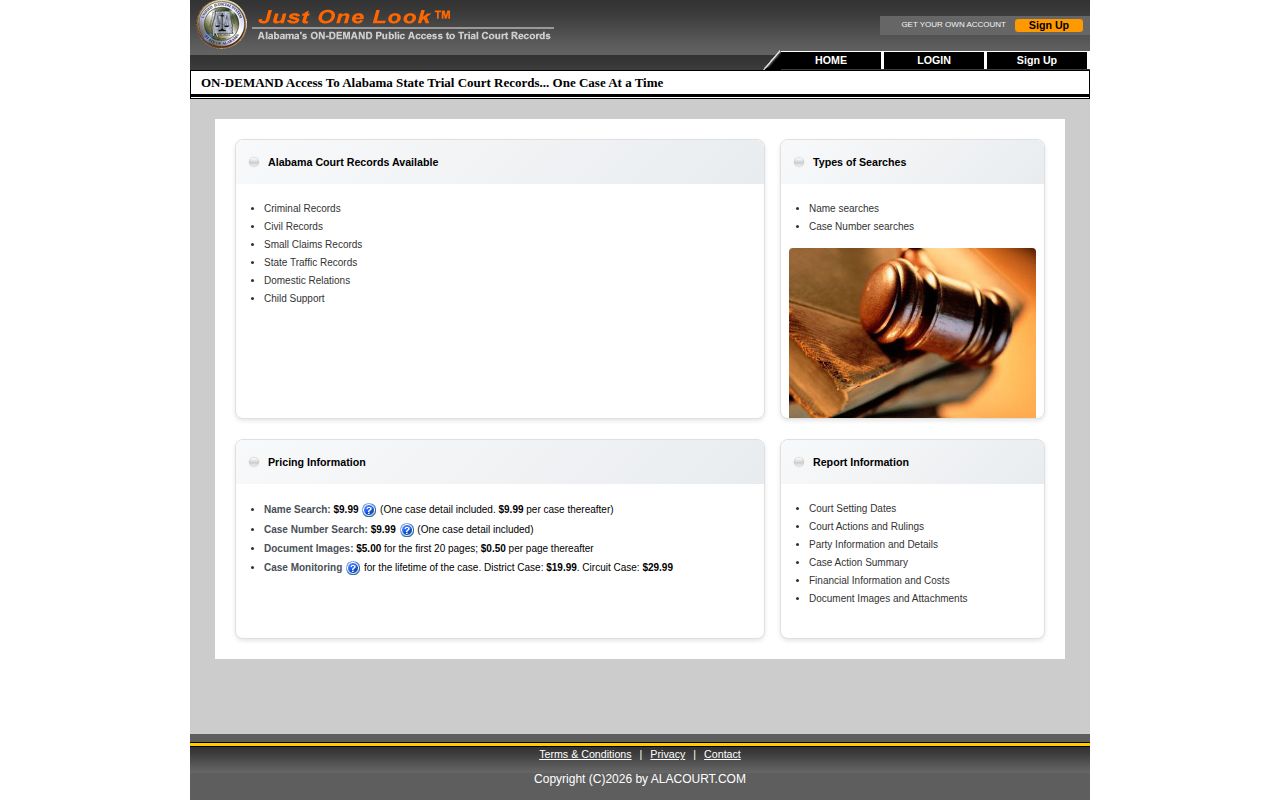
The court portal is useful for locating a case, but official copy needs and certification questions still route through the clerk's record request process.
Request Etowah Court Copies
The clerk's record request page gives unusually specific copy instructions. A written request should include the requester's name, address, and contact phone number; the documents needed; whether certification is required; and identifiers such as case number, party names, style of case, dates of birth, aliases, charges, and case type. If records will be mailed, include a self-addressed stamped envelope. If the requester will pick up records, provide a phone number for pickup notice.
- Search the public terminal or Just One Look to identify the case before asking for copies.
- Prepare the case identifiers and the specific documents needed, such as docket entries, orders, bond records, sentencing orders, or probation orders.
- State whether certification is required, since certification is a separate fee.
- Include a money order for mailed requests. The clerk's page says personal checks are not accepted.
- Allow for the clerk's processing caution, which says requests may take up to 30 days due to minimal staffing.
| Item | Amount from clerk source |
|---|---|
| Archived or microfilmed records search | $25 |
| Copies up to 20 pages | $5 |
| Each additional copy page | $0.50 |
| Certification | $5 |
Etowah Court Records Contact
The Etowah County Circuit Clerk is located in the Judicial Building on Forrest Avenue. That is separate from the Sheriff's Office and Detention Center. The sheriff may confirm release timing, but the clerk is the path for court copies, public terminal searching, case dispositions, and expungement filing information. The clerk's office cannot provide legal advice, so requests should focus on records and copies rather than advice about what a release means.
Etowah County Circuit Clerk
801 Forrest Avenue, Suite 202
Gadsden, AL 35901
256-549-2181
Phone menu: 256-549-2150
Note: A certified court copy can take longer than a same-day jail release update, even when the person has already left custody.
Etowah Release Disposition Fields
Court records are strongest when the release question depends on legal status. A sheriff release entry may show charge text, bond, and release date, but that does not prove whether the charge was dismissed, amended, sentenced, or tied to probation. The disposition record can show the outcome that the jail roster cannot fully explain.
| Court record item | Release question it can answer |
|---|---|
| Bond order or bond status | Whether release was tied to bond and conditions. |
| Disposition entry | Whether charges were dismissed, amended, convicted, or otherwise resolved. |
| Sentencing order | Whether time served, sentence length, jail credit, or probation affected release. |
| Probation order | Whether supervision followed release and which terms may appear in the case. |
| Revocation or warrant entries | Whether later court action changed custody status. |
Etowah Expungement After Release
Etowah has a local expungement workflow page. It says an expungement checklist may be obtained from the Circuit Criminal Division at the same Judicial Building address. Petitions for records from Etowah County District Court or any municipal court in Etowah County must be filed in the Circuit Criminal Division. The local page states that the filing fee increased to $500 effective July 1, 2021, and it points users to Form 65 on Alabama e-forms and ALEA's criminal-record expungement kit.
The timing details matter for release-record research. The clerk page describes a 45-day point for district attorney or municipal prosecutor objection. If an objection is filed, a hearing should be set no sooner than 14 days from the objection filing date. If no objection is filed, the judge may rule with or without a hearing, and the clerk says to allow up to 60 days for notice of ruling. An expungement can later restrict access to arrest or court materials, but it is a court process. A jail release alone does not erase the record.
For a county jail release route, pair the court result with the sheriff record. For a state prison release route, use ADOC and post-release supervision sources as well. The broader release search sequence appears on Etowah County released inmates.
Expungement timing also explains why two searches can disagree. A jail record may have appeared during the 48-hour release window, while a later court order may restrict access to court or arrest materials. The clerk's process is the local route for the petition and ruling notice, and ALEA materials reinforce that Alabama courts grant expungements. Treat a missing public record as a prompt to verify with the clerk, not as proof that no arrest, release, or court event occurred.
The public terminal and written-copy route also help when a person has only partial jail information. A booking number from the sheriff release page is useful, but the court request may need party names, date of birth, aliases, charge, case type, or the style of the case. Better identifiers reduce wrong-person matches and make the copy request narrower. That is especially important in Etowah County because the sheriff's online release list is short-lived while court records remain the longer path.
For release-date disputes, court records can also show the order that controlled custody. The docket may point to bond, time served, probation, sentence completion, a warrant, or transfer to another authority. Those entries are different from the sheriff's public release date. Reading both records together gives a cleaner answer: the jail record gives the custody timestamp, and the court record gives the legal action that made the release possible.
Etowah Court Release Chain
The court page matters because it outlasts the sheriff's rolling release roster. A person can leave the jail on bond, after time served, after dismissal, after a probation order, after a sentence, or after transfer to another authority. The jail record shows custody timing, but the court record can show the order or disposition that made the release possible. That is why the Circuit Clerk's public terminal, Just One Look access, and written copy process are central after the 48-hour jail window closes.
The clerk's written request instructions also help avoid wrong-person matches. Include the case number when known, party names, style of case, dates of birth, aliases, charges, and case type. If the case later becomes sealed or expunged, the court record is also the source that explains why access changed. For a release search, the court file should be used as a legal-status record rather than a live custody roster.
Court timing can be slower than jail timing. A person may leave jail today while certified copies or archived record searches take longer. The clerk's fee schedule and processing caution should be read as court-copy rules, not as a promise about how fast a jail release appears online.
Public Record Search
Sponsored Results