
Gadsden ABPP Release Supervision
The Alabama Bureau of Pardons and Paroles is the state agency for parole and probation supervision. For Etowah County, the local contact is the Gadsden Field Office in the Etowah County Judicial Building. That location matters because the Circuit Clerk is also in the Judicial Building, while the sheriff and Detention Center are nearby on Forrest Avenue. A release question may move between all three offices depending on whether the issue is jail custody, court disposition, or post-release supervision.
The Gadsden office is not a replacement for the sheriff's 48-hour release roster. It becomes relevant when a person is released from state prison to parole, mandatory release, medical parole, probation after a split sentence, or another ABPP-supervised status. It can also be the local route for reporting-office questions, release scheduling, supervision status, and revocation or absconder issues when public web pages do not answer the question.
The ABPP Gadsden Field Office page is the matching local source for Etowah County supervision contact details.
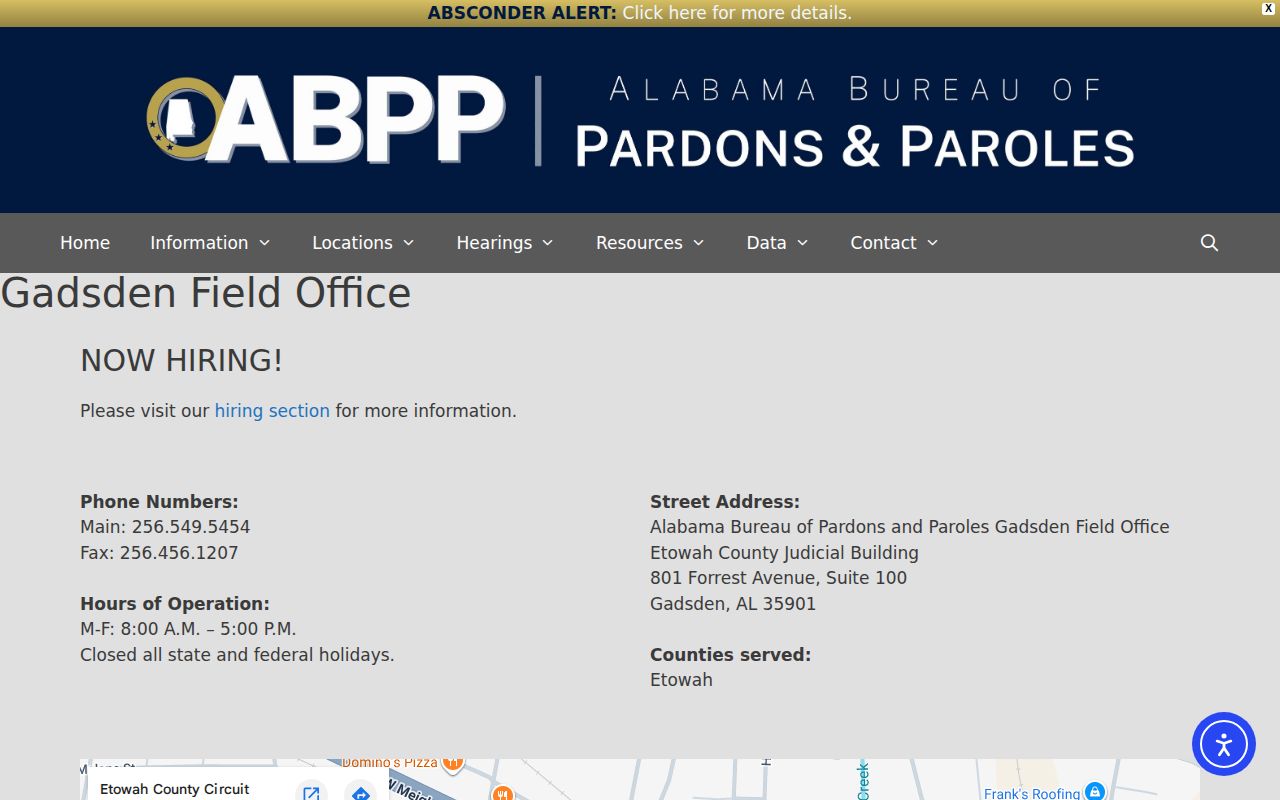
The local office source supports the main route: use Gadsden ABPP for Etowah supervision after a state release, not for a recent county jail booking alone.
Verify Etowah Post-Release Supervision
Verification starts by separating parole, probation, mandatory release, and ordinary jail release. Parole is release from prison supervision before the sentence fully ends. Probation is a court-ordered supervision sentence that may occur instead of, or after, jail or prison time. Mandatory release is a statutory state-prison release mechanism that can place a person under supervision before the sentence end date. A county jail bond release is different and usually routes back to the sheriff and court.
- Confirm whether the person was sentenced to ADOC or only released from Etowah County jail.
- Use ADOC current-custody search if the person may still be in state prison.
- Check ABPP hearing schedules and results when parole consideration or parole action is the issue.
- Contact the Gadsden Field Office for local supervision questions that are not resolved by public results.
- Use Etowah court records for probation orders, split-sentence terms, warrants, revocations, and case disposition.
| Status | Meaning | Primary route |
|---|---|---|
| Parole | State prison release to ABPP supervision. | ABPP hearing results, Gadsden Field Office, ADOC context. |
| Probation | Court-ordered supervision tied to the sentence. | Etowah court records and ABPP field office if supervised by ABPP. |
| Mandatory release | State release mechanism based on statute and sentence length. | ADOC calculation, ABPP supervision preparation. |
| County jail release | Release from Etowah County Detention Center. | Sheriff 48-hour roster, Detention Center, court record. |
Gadsden Field Office Contact
The ABPP Gadsden Field Office serves Etowah County. The research lists it at the Etowah County Judicial Building, Suite 100, with weekday hours and a local phone and fax. This is the required contact card for the post-release supervision office. It should be used for supervision questions, not as a jail records line.
Alabama Bureau of Pardons and Paroles, Gadsden Field Office801 Forrest Avenue, Suite 100
Gadsden, AL 35901
256-549-5454
Fax 256-456-1207; Monday-Friday 8:00 a.m.-5:00 p.m., closed state and federal holidays.
For jail custody, call the Etowah County Detention Center. For court orders, contact the Circuit Clerk. For current ADOC custody and release-date field definitions, use ADOC sources. The correct release confirmation route depends on which agency controlled the person after release.
Etowah Parole Hearing Results
ABPP publishes scheduled parole hearings, current-year parole results, archived parole results, and general hearing information. The general hearing information source says parole and pardon hearings are held in open public meetings each week on Tuesday, Wednesday, and Thursday unless otherwise noted, at 301 South Ripley Street in Montgomery. The public meeting begins at 8:00 a.m., and hearings are called at the board's discretion.
The results pages must be read carefully. A granted parole result does not mean the person walked out of custody that day. ABPP's FAQ says the agency verifies the home plan and coordinates with ADOC to schedule release on parole. It also says the agency may be called Wednesday afternoons for a list of releases scheduled for the following Monday. A reset date is not a new hearing date; ABPP says it is the first month and year the person will be considered for placement on a future docket.
Use scheduled parole hearings before a board action and current-year parole results after a hearing. Archived results can help when the action occurred in an earlier year.
Alabama Supervision Release Rules
ABPP's FAQ explains that parole eligibility is calculated under Alabama Code Section 15-22-28(e), considering sentence, crime, jail credit, ability to earn good time, time served, and sentencing-court orders. For specified Class A felonies committed on or after March 21, 2001, initial parole consideration is after 85 percent of the total sentence or 15 years, whichever is less. For many other prisoners, initial consideration is generally after one-third of the sentence or 10 years, whichever is less. That is consideration timing, not a promise of release.
Mandatory release under Section 15-22-26.2 is separate from discretionary parole. ABPP says ADOC determines the mandatory release date and coordinates with ABPP to prepare for release to supervision. Medical parole under Section 15-22-43 is also separate and depends on statutory criteria and medical determinations. These state-prison concepts should not be applied to a simple Etowah County jail release without a state sentence record.
For the broader supervision page, use Etowah County post-release supervision.
These rules also explain why a county jail release page cannot confirm every supervision status. A person may leave Etowah County Detention Center on bond with no state supervision, or may leave ADOC on parole with a reporting duty in Etowah County. The Gadsden office fits the second situation. If the source event was a court sentence to probation, the Etowah court record should be checked with the ABPP office because the court order is the starting record for the supervision term.
When a parole result is granted, check for the next custody step instead of stopping at the result page. ABPP's FAQ says home-plan verification and ADOC coordination happen before release on parole. That means a person can have a favorable board result and still remain in ADOC custody until the release is scheduled. For Etowah County, the Gadsden office is the local follow-up once supervision is active or expected.
Absconder, revocation, and warrant concerns also belong outside the ordinary sheriff release roster. ABPP supervision records and public resource areas may show that a person on supervision has a later status issue, while the Etowah court file may show a revocation case or warrant activity. Those events can occur long after the original jail release. Use the Gadsden office and court records together when a supervision status appears to have changed.
Etowah Supervision Follow-Up
The Gadsden Field Office is the local follow-up point when a release from state custody turns into parole, probation, mandatory release, or another ABPP-supervised status in Etowah County. It does not replace the sheriff's jail release roster for a county bond-out, and it does not replace the court file for disposition. Its role begins when the person is under state supervision or when ABPP hearing, result, home-plan, or release-scheduling information is the relevant source.
ABPP's FAQ explains why a granted parole result should be checked carefully. A grant does not always mean same-day release because ABPP verifies the home plan and coordinates with ADOC before release on parole is scheduled. The current-year results page also warns that a reset date is a future consideration marker, not a new hearing date. For Etowah release searches, those distinctions keep supervision status separate from physical release timing.
Probation is different from parole. Probation is tied to a court order and may follow a county sentence, split sentence, or local case disposition. Parole follows state-prison release and ABPP action. If the person was released from the Etowah jail without an ADOC sentence, start with the court and sheriff record before calling the field office.
Public Record Search
Sponsored Results