
Etowah County Supervision Types
Parole and probation both involve supervision in the community, but they start from different legal events. Parole usually follows an Alabama Department of Corrections prison sentence after the Alabama Board of Pardons and Paroles grants release or after a statutory release path moves the person to supervision. Probation is tied to a court sentence and may be ordered instead of jail time, after a split sentence, or after a local case disposition. A released Etowah County person can have no supervision, county-court probation, ABPP parole, mandatory release supervision, medical parole, or a revocation case.
The county jail release roster is not built to answer that full question. It may show the release date, booking number, charges, bond, and arresting agency, but it does not consistently show a public "released to parole" or "released to probation" field. For supervision, the better route is the Alabama Bureau of Pardons and Paroles, the Etowah court file, and, for covered state-prison cases, Alabama Victim Notification System status notices.
| Supervision path | What it means | Best Etowah source |
|---|---|---|
| Parole | Release from ADOC custody before sentence end, subject to board conditions. | ABPP hearing results, parole minutes, and the Gadsden Field Office. |
| Probation | Court-ordered supervision tied to a sentence, plea, split sentence, or revocation. | Etowah County court records and ABPP local supervision contacts. |
| Mandatory release | A statutory state-prison release path coordinated by ADOC and ABPP. | ADOC mandatory-release contacts and ABPP supervision records. |
| Discharge | End of custody or supervision duties after the sentence or supervision term closes. | Court orders, ABPP record channels, or ADOC records contacts. |
- Parole
- Conditional release from state prison supervision before the sentence fully expires.
- Probation
- Community supervision ordered by a court, often with reporting and conduct rules.
- Absconder
- A supervised person reported as not reporting or not available to supervision.
- Revocation
- A court or board action that can return a supervised person to custody after a violation.
Verify Etowah County Supervision
The practical verification path starts with the custody source and then moves to the supervision source. If the person was just released from the Etowah County Detention Center, confirm the booking and release through the sheriff's release roster or the Detention Center. If the person was sentenced to state prison, ADOC and ABPP become more important than the county jail page. If the question is whether the person is on probation after a court case, the Etowah court record may show the sentencing order or later revocation filings.
- Confirm the custody event first. Use the sheriff's 48-hour released roster for a recent county jail release, or use the ADOC search while the person is still in state custody.
- Search ABPP public pages for scheduled parole hearings, current-year parole results, and archived parole results when a state-prison parole decision is involved.
- Check the hearing minutes for special conditions when ABPP notes that conditions are found in the minutes for the hearing date.
- Contact the ABPP Gadsden Field Office when the issue is Etowah County reporting, local supervision, or a local office contact.
- Use the Etowah Circuit Clerk record request process when the release may be tied to probation, dismissal, bond, sentence completion, or a revocation order.
For a person still waiting on release, timing can be less direct than the result page suggests. ABPP's FAQ says parole eligibility depends on sentence, crime, jail credit, ability to earn good time, time served, and sentencing-court orders. A set date is not the same as a guaranteed hearing date. If parole is granted, ABPP verifies the home plan and coordinates with ADOC before release on parole is scheduled.
Note: A parole grant, a reset month, and a completed release are three different events in Alabama records.
Etowah County ABPP Office
Etowah County's local supervision office is the Alabama Bureau of Pardons and Paroles Gadsden Field Office. It is in the same Etowah County Judicial Building as the Circuit Clerk, which makes the local route more direct when a release record, court order, and supervision record all need to be reconciled. This office is the field contact for Etowah County parole and probation supervision questions after a person leaves state custody or is placed under ABPP supervision.
The ABPP Gadsden Field Office page identifies the Etowah County office and its public contact details.
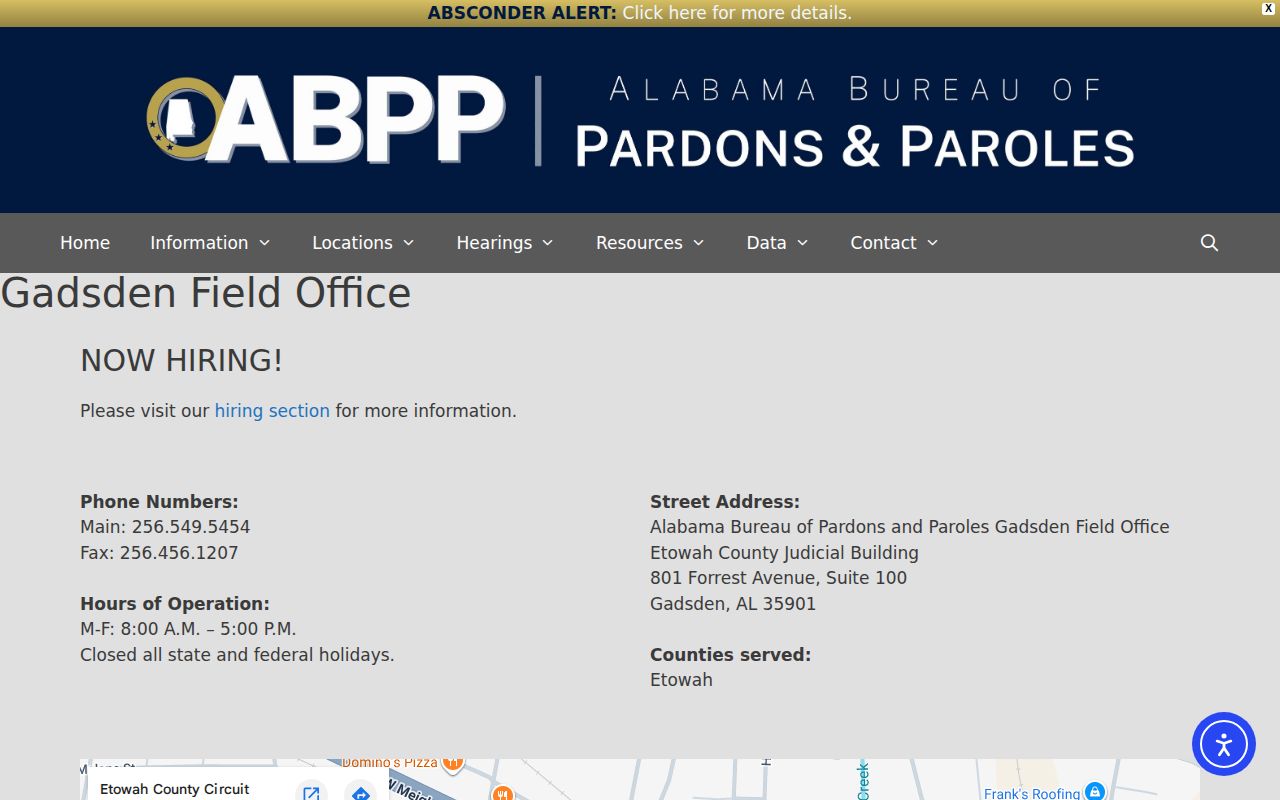
The field office listing is the strongest local source for where Etowah County supervision is handled after an ADOC or court-supervised release.
Alabama Bureau of Pardons and Paroles, Gadsden Field Office
Etowah County Judicial Building
801 Forrest Avenue, Suite 100
Gadsden, AL 35901
Phone: 256-549-5454
Fax: 256-456-1207
Hours: Monday-Friday, 8:00 a.m.-5:00 p.m.
Etowah County Parole Results
Parole hearing records are a separate step from local release confirmation. ABPP posts scheduled parole hearings and current-year results, with an archive for older results. General hearing information says parole and pardon hearings are usually held Tuesday, Wednesday, and Thursday unless otherwise noted. The open public meeting begins at 8:00 a.m. at 301 South Ripley Street in Montgomery, and hearings are called at the board's discretion.
The result language needs care. A grant is not the same as a same-day walkout. ABPP's FAQ says the agency verifies a home plan and coordinates with ADOC to schedule release on parole. The current-year results page also says a reset date is the first month and year the person will be considered for placement on a future docket, not a new hearing date. For a family member or attorney trying to track a release, the result page is one checkpoint, then ADOC and ABPP scheduling still matter.
ABPP's scheduled parole hearings page shows the public hearing schedule for state parole matters.
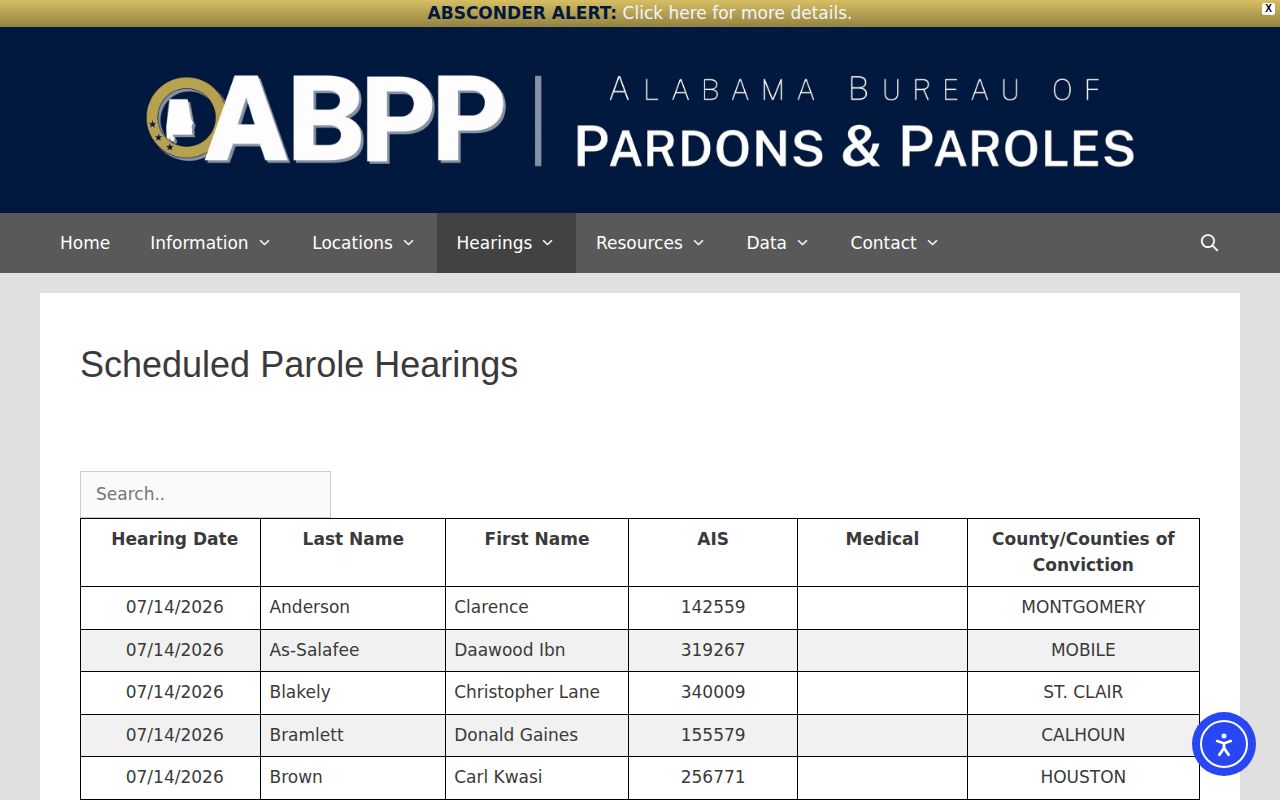
Use the hearing schedule before a board date and the results pages after the meeting to separate eligibility, board action, and completed release.
Etowah County Violation Status
Supervision conditions can include reporting, residence approval, treatment, travel limits, payment duties, and compliance with new court orders. The exact terms are case-specific. A public page should not guess those terms from the jail roster. Instead, use the court order, ABPP minutes when special conditions are referenced, and the local field office when the person is under Etowah County supervision.
Violation records can appear in more than one place. A probation violation may show in the Etowah court case as a revocation filing, warrant, or hearing. A parole violation may appear through ABPP records, delinquency status, or later custody movement. Alabama Victim Notification System can provide custody or status notifications only for covered offenders convicted in Alabama and sentenced to prison, so it is not a broad Etowah jail release lookup. It can still help when the person is in the ADOC/VNS coverage lane.
| Question | Where to verify |
|---|---|
| Was parole granted? | ABPP current-year results or archived parole results. |
| Has release on parole been scheduled? | ABPP release scheduling guidance and ADOC coordination. |
| Is there a probation revocation? | Etowah County court docket and Circuit Clerk record request. |
| Did custody status change? | VNS for covered state-prison offenders, sheriff records for county jail cases. |
Etowah County Mandatory Release
Mandatory release is not the same as discretionary parole. ABPP's FAQ says mandatory release under Alabama Code Section 15-22-26.2 applies to offenses committed on or after January 30, 2016, with exclusions such as sex offenses involving a child and life sentences. ADOC determines the mandatory release date and coordinates with ABPP to prepare for release to supervision. That makes mandatory release a state-prison supervision path, not a county jail roster field.
Medical parole is another narrow state route. ABPP cites Alabama Code Section 15-22-43 and explains that ADOC makes medical determinations and sends lists of potential medical-parole candidates to ABPP for a medical parole docket. For Etowah County post-release supervision, both mandatory release and medical parole should be checked through state sources first, then followed locally through the Gadsden Field Office if supervision is assigned in Etowah County.
Etowah County Supervision Discharge
Supervision ends through discharge, sentence expiration, court order, board action, or another case-specific event. A discharge means the supervision duty has ended. It does not rewrite the jail release date, and it does not by itself erase the court file. To understand the complete path, match the custody source, the supervising agency, and the court record.
The sheriff release record confirms that a person left the Etowah County Detention Center during the public roster window. The court record may explain whether the release followed bond, dismissal, sentence completion, probation, or another order. ABPP records may show parole, mandatory release, special conditions, violation status, or discharge. For the custody record side of the same problem, the broader Etowah release search path is covered on the Etowah County released inmates page.
Note: Expungement, sealing, juvenile limits, and protected filings can restrict what later appears in public court or supervision records.